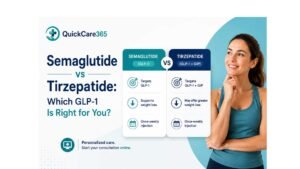
In the first head-to-head trial between them, tirzepatide produced greater average weight loss than semaglutide — 20.2% versus 13.7% of body weight over 72 weeks. That’s a meaningful gap. But average results don’t decide individual treatment, and cost, side-effect tolerance and product availability often matter more in practice.
How they differ mechanically
This one difference explains most of the rest.
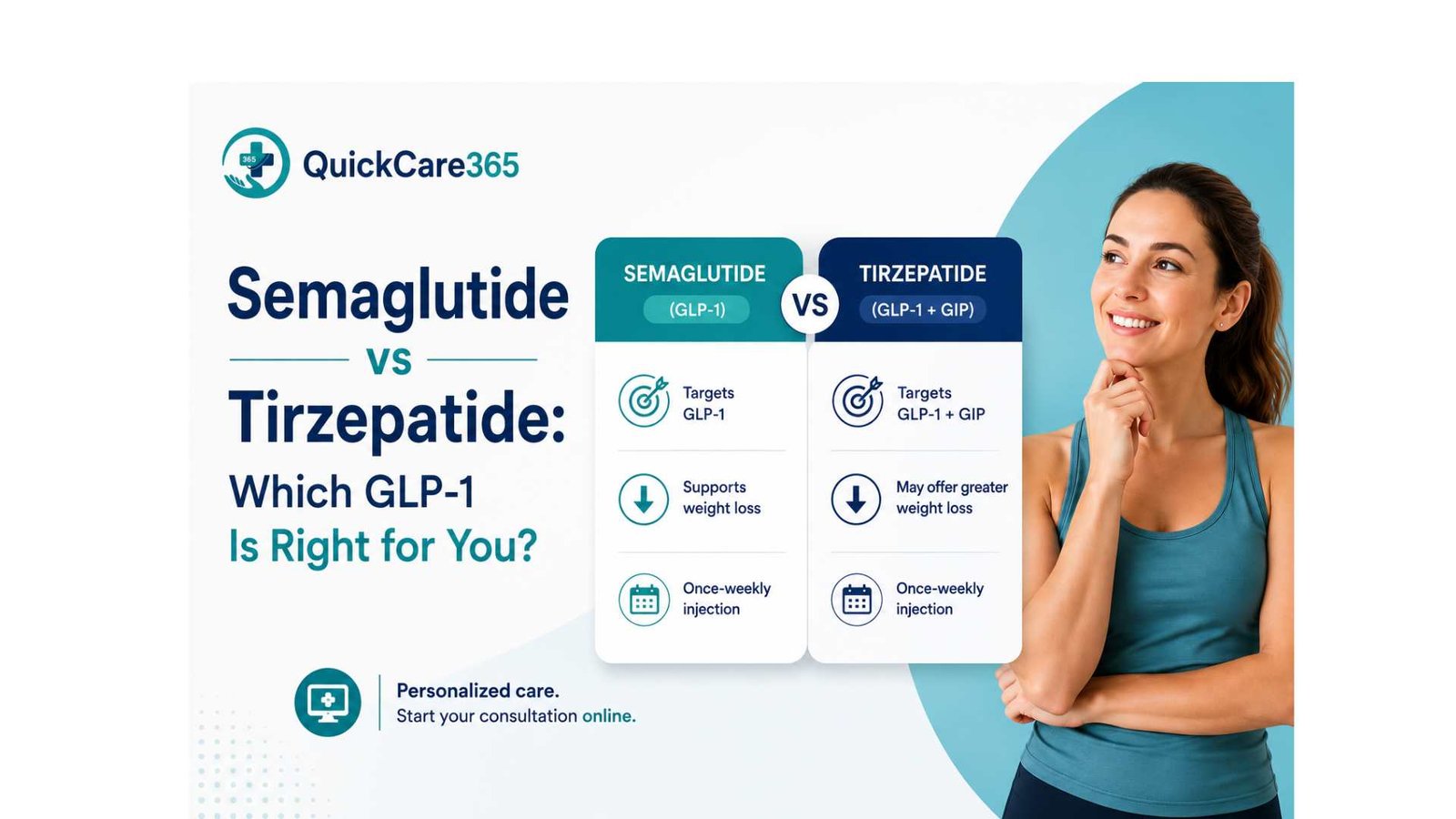
Semaglutide is a GLP-1 receptor agonist. It mimics glucagon-like peptide-1, a hormone your gut releases after eating, which slows stomach emptying, signals fullness to the brain and helps regulate blood sugar.
Tirzepatide does the same thing and activates a second receptor, GIP (glucose-dependent insulinotropic polypeptide). Hitting two incretin pathways rather than one appears to be why it produces larger average results.
What the head-to-head data shows
SURMOUNT-5, published in the New England Journal of Medicine, randomised 751 adults with obesity — or overweight plus at least one weight-related condition — and without type 2 diabetes, to maximum tolerated doses of either drug for 72 weeks.
| Tirzepatide | Semaglutide | |
|---|---|---|
| Average body weight loss at 72 weeks | 20.2% | 13.7% |
| Average absolute loss | ~22.8 kg | ~15.0 kg |
| Achieved ≥25% weight loss | 31.6% | 16.1% |
Tirzepatide also showed greater improvements in blood pressure, HbA1c, fasting insulin and triglycerides.
Two caveats worth stating plainly. The trial was open-label — participants and investigators knew which drug they were receiving — and it was funded by Eli Lilly, tirzepatide’s manufacturer. Independent real-world analyses have broadly supported the direction of the finding, but keep the study design in mind rather than treating 20.2% as a personal forecast.
One more thing the trial surfaced: weight loss was around 6% lower in men than women in both groups. Averages conceal a lot of individual variation.
Side effects: different, not simply better or worse
Both are generally well tolerated, and both produce mostly mild-to-moderate gastrointestinal effects that are worst during dose escalation.
The profiles differ in character. Semaglutide more often causes nausea and constipation. Tirzepatide more often causes diarrhoea, with somewhat less nausea. Neither pattern is universal, and which one you find more tolerable is genuinely individual.
Common effects for both: nausea, vomiting, diarrhoea or constipation, abdominal discomfort, fatigue, reduced appetite.
Serious but uncommon concerns include pancreatitis, gallbladder problems and, in animal studies, thyroid C-cell tumours — which is why both carry a contraindication for people with a personal or family history of medullary thyroid carcinoma or MEN2 syndrome.
Most GI effects are manageable with slow titration, smaller meals, avoiding high-fat food and adequate hydration. Rushing the dose escalation is the most common avoidable mistake.
Cost — the factor that decides it for most people
This is where the picture changed dramatically during 2025 and 2026, and where any article can go out of date quickly.
Both manufacturers now sell directly to self-paying patients at far below list price. As of mid-2026, manufacturer direct-pay programmes put branded tirzepatide roughly in the $299–$449 per month range depending on dose, and branded semaglutide roughly $349–$499 per month, with lower promotional tiers and a newer oral semaglutide option priced lower still. List prices — around $1,000–$1,350 a month — are now paid by almost nobody.
Two structural points to understand:
- Self-pay purchases usually don’t count towards your insurance deductible. You’re paying entirely outside your plan.
- Programme terms have conditions. Some require refilling within a set window to hold the discounted rate.
Because these programmes change repeatedly, treat any figure — including these — as a starting point and check current pricing directly before you commit.
The oral options changed the calculation
Until recently, effective GLP-1 treatment meant a weekly injection. That’s no longer the only route.
An oral semaglutide formulation for weight management has come to market at a lower price point than the injectable pens, and orforglipron — a daily oral GLP-1 pill from Eli Lilly — received FDA approval in April 2026 and is now dispensed through several major pharmacies and telehealth platforms.
The trade-off is dose ceiling: the oral products deliver lower doses than maximum-strength injectables, so average weight loss is generally smaller. For someone who is needle-averse, or who wants to start at a lower cost and lower intensity, that trade may be entirely worthwhile. For someone targeting the largest possible reduction, it probably isn’t.
Compounded versions: what changed
During the 2023–2024 shortages, compounded semaglutide and tirzepatide were widely sold through telehealth platforms at a fraction of brand pricing. That was legal because federal rules permit compounding of drugs on the FDA shortage list.
Once the shortages resolved, that exemption lapsed. The FDA has since moved further, proposing to remove semaglutide, tirzepatide and liraglutide from bulk compounding lists entirely, with narrow exceptions for documented individual clinical need. Aspects of this remain in active litigation.
What this means for you: compounded products are no longer the straightforward cheap route they were, the legal position is unsettled, and compounded products are not FDA-approved — meaning they haven’t been evaluated for safety, efficacy or manufacturing quality in the way branded products have. Anyone selling you one should be explaining that clearly.
Who’s eligible?
Both are approved for chronic weight management in adults with a BMI of 30 or above, or 27 or above with at least one weight-related condition such as high blood pressure, type 2 diabetes, high cholesterol or obstructive sleep apnoea.
Not appropriate if you’re pregnant or breastfeeding, have a personal or family history of medullary thyroid carcinoma or MEN2, have had pancreatitis, or have certain gastrointestinal conditions.
A provider will review your medical history, current medications and often baseline lab work before prescribing. Booking a visit doesn’t guarantee a prescription — that’s the point of the evaluation.
What happens if you stop?
Weight regain after discontinuation is common and well documented across trial extension data. These medications treat obesity as a chronic condition; stopping removes the mechanism.
That doesn’t mean everyone stays on them permanently, but it does mean a maintenance plan should be part of the conversation from the start rather than an afterthought. Any programme that doesn’t raise this with you isn’t preparing you properly.
Which one should you choose?
Honestly: this isn’t a decision to make from an article.
The data favours tirzepatide on average weight loss. But the right choice depends on your medical history, which side-effect profile you’re likely to tolerate, what your insurance covers, what you can sustain paying, what’s actually available, and whether an oral option suits you better than an injection.
QuickCare365’s GLP-1 programme includes a $49 video consultation with a licensed provider who reviews eligibility, discusses options and monitors progress. Medication is billed separately by your pharmacy.
Frequently asked questions
Which works better for weight loss?
In head-to-head data, tirzepatide produced greater average loss. Individual response varies considerably.
Can I switch from one to the other?
Often yes, under provider supervision — typically restarting at a lower dose and titrating up.
Do I need lab work first?
Usually. Baseline labs help identify contraindications and establish a monitoring baseline.
Is it covered by insurance?
Many plans exclude weight-management indications even when they cover the same molecule for diabetes. Check your specific plan.
Are compounded versions safe?
They aren’t FDA-approved and haven’t been evaluated for safety, efficacy or manufacturing quality. The regulatory position has also tightened significantly. Discuss it with a provider before considering one.