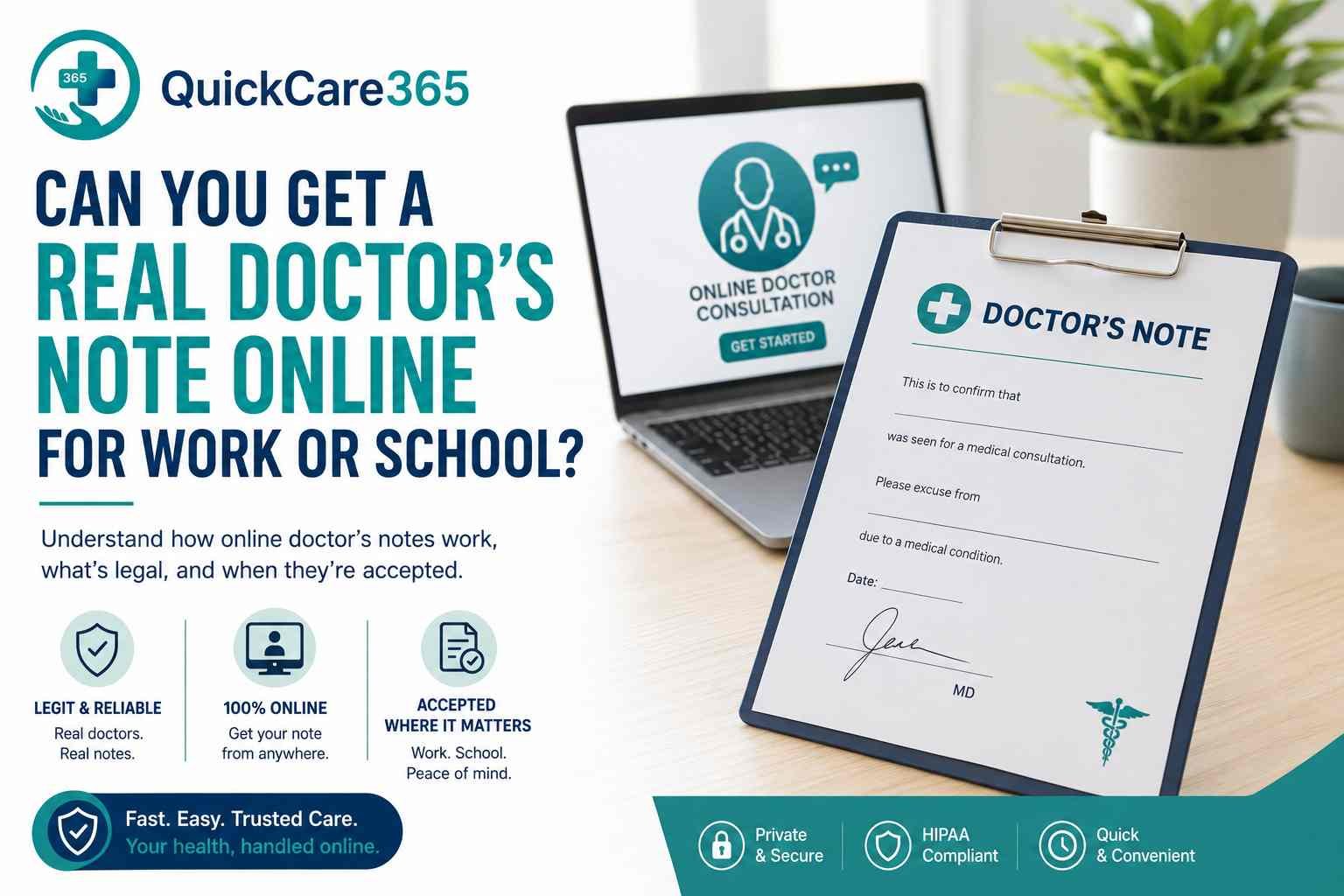
Yes. A licensed provider can issue a legitimate doctor’s note after an online consultation, and most employers and schools accept it. The note has to follow a genuine medical evaluation — no legitimate service issues one without an actual consultation. At QuickCare365, an excuse letter costs $10 in addition to a $14.99 consultation and is typically available within four hours.
Is an online doctor’s note actually legitimate?
This is the question almost everyone is really asking, so let’s be direct.
A doctor’s note is legitimate because of who wrote it, not where the visit happened. A note issued by a licensed clinician who evaluated you carries the same standing whether that evaluation happened in an exam room or over a video call. Telehealth is a recognised form of medical practice regulated by the same state boards that oversee in-person care.
What makes a note illegitimate is the absence of a real evaluation. There are websites selling downloadable templates, “verified” notes with no consultation, and backdated documentation. Those are forgeries. Presenting one to an employer is a serious matter and can be grounds for dismissal.
The distinction is simple: did a licensed provider assess you and reach a clinical judgement? If yes, the note is real. If you filled in a form and paid for a PDF, it isn’t.
What a valid doctor’s note contains
A note that will hold up should include:
- The provider’s full name and credential (MD, DO, NP, PA)
- Their licence number and the state of licensure
- The date of the consultation
- The dates you’re being excused from work or school
- Any recommended restrictions, such as light duty or no physical activity
- A signature and a way for the recipient to verify the note
Note what isn’t there: your diagnosis. Under HIPAA, a provider generally doesn’t disclose your specific medical condition to your employer without your consent. A standard note confirms that you were evaluated and states the recommended time off. If your employer asks for the diagnosis itself, you decide whether to share it — that’s your call, not theirs by default.
How to get one online, step by step
- Book a consultation. Choose messaging or video. Messaging is usually enough for a straightforward illness.
- Describe your symptoms. Be accurate — when symptoms started, how severe they are, whether they’re improving, and what you’ve already tried.
- The provider evaluates you. They review your symptoms, history and any relevant risk factors, and decide on a treatment plan.
- Request the note. Ask during the visit. If the provider agrees it’s clinically appropriate, they’ll issue it.
- Receive it. At QuickCare365 the note is delivered through your patient portal, typically within four hours of a messaging consultation.
The whole process usually takes less time than the drive to an urgent care clinic.
Does your employer have to accept it?
Mostly this comes down to your employer’s own policy rather than the law.
Under the Family and Medical Leave Act, employers with 50 or more employees may require medical certification for qualifying leave — and a licensed telehealth provider can complete that certification. Some employers have written policies specifying an in-person examination for absences beyond a certain length, and those policies are generally enforceable.
Practical advice: check your employee handbook before you book, especially if you’ll be out for more than two or three days. Most employers accept a telehealth note without question. A small number don’t, and it’s cheaper to find out first.
Schools are typically more flexible. Most accept any note from a licensed provider.
How many days can the note cover?
There’s no fixed legal limit — it’s a clinical judgement based on your condition and how long you’re likely to be unwell or contagious.
For most acute illnesses, a provider will typically excuse one to three days, which covers the period when you’re most symptomatic and most likely to be infectious. Conditions with a longer course, or work involving food handling, healthcare or close customer contact, may warrant longer.
If you need more time than the note covers, book a follow-up rather than asking for an extension retrospectively. A provider can only certify what they’ve evaluated.
One practical point: if you’re likely to be out for more than a few days, check whether your employer requires an in-person examination for extended absences before you book a virtual visit.
What no legitimate service will do
Be wary of any provider that offers these — and understand why QuickCare365 doesn’t:
Backdate a note. A provider can only document an evaluation on the date it happened. They may note that you reported symptoms starting earlier, which is different from certifying an examination that never took place.
Issue a note without a consultation. There’s nothing to certify without an evaluation.
Guarantee a note in advance. A provider may conclude you’re well enough to work, or that your condition needs in-person assessment. Either is a legitimate outcome.
Write a note for someone else. The person being excused has to be the person evaluated.
A service that advertises around these limits is selling a forged document, not medical care.
Work note vs school note
The content is largely the same. Two practical differences:
Work notes more often need to specify restrictions rather than full absence — light duty, no lifting, no customer contact while contagious. Tell the provider what your job involves so the note is useful.
School notes frequently need to cover a specific number of days and may need to reference a return-to-school date. If your child is the patient, a parent or guardian needs to be present for the consultation.
For contagious illnesses, employers and schools often have their own exclusion rules — commonly 24 hours fever-free without medication. Your provider can advise on this.
What it costs
At QuickCare365, an excuse letter is $10 on top of your consultation:
| Cost | |
|---|---|
| Messaging consultation | $14.99 |
| Excuse letter | $10.00 |
| Total | $24.99 |
A walk-in urgent care visit for the same purpose typically runs $100–$250 self-pay, plus travel and waiting time.
Frequently asked questions
How fast can I get a doctor’s note online?
With QuickCare365, messaging consultation summaries and notes are typically available within four hours, or two hours with an urgent messaging consultation.
Can I get a note for a day I was already sick?
A provider can document that you reported symptoms beginning on an earlier date, but cannot certify an examination that didn’t occur. If you’ve already missed days, book as soon as possible.
Will the note show my diagnosis?
Not usually. A standard note confirms you were evaluated and states the recommended time off, without disclosing your condition.
Is my consultation confidential?
Yes. Telehealth visits with a licensed provider are protected health information under HIPAA. Your employer receives only the note you choose to give them.
What if the provider decides I don’t need time off?
That’s a possible outcome of any genuine evaluation. You’ll still receive treatment advice and a visit summary, and the consultation fee still applies.
Can I get a note for my child?
Yes, with a parent or guardian present for the consultation.