
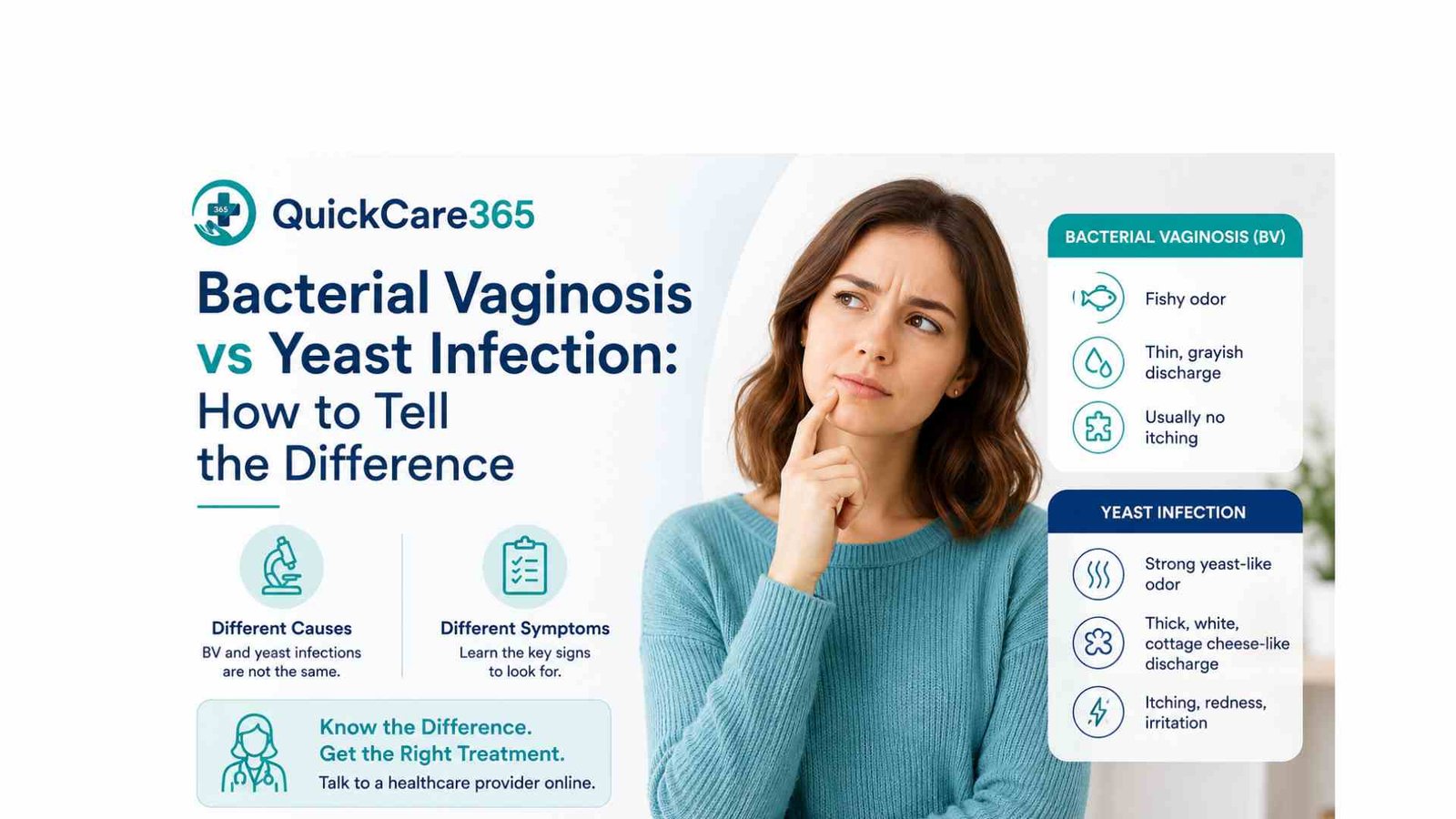
The clearest difference is discharge and smell. Bacterial vaginosis typically causes thin, greyish-white discharge with a strong fishy odour, often worse after sex. A yeast infection typically causes thick, white, odourless discharge with intense itching. BV is treated with antibiotics; yeast infections are treated with antifungals. Using the wrong one won’t work.
| Bacterial vaginosis | Yeast infection | |
|---|---|---|
| Discharge | Thin, watery, grey or white | Thick, white, clumpy — often described as cottage-cheese-like |
| Odour | Strong, fishy, worse after sex | Usually none |
| Itching | Mild or absent | Intense — often the main complaint |
| Burning | Sometimes | Common, especially when urinating |
| Redness/swelling | Uncommon | Common on the vulva |
| Vaginal pH | Above 4.5 | 4.5 or below |
| Cause | Imbalance of normal vaginal bacteria | Overgrowth of Candida yeast |
| Treatment | Prescription antibiotics | Antifungals (OTC or prescription) |
If you take one thing from this table, make it the odour and the itching. Strong fishy smell with little itching points towards BV. Intense itching with no real smell points towards a yeast infection.
Bacterial vaginosis in more detail
BV happens when the balance of bacteria that normally live in the vagina shifts — protective Lactobacillus species decline and other bacteria increase.
It is genuinely common, and it is not a sexually transmitted infection, though sexual activity can change the vaginal environment and make it more likely. You can develop BV without ever having been sexually active.
Symptoms:
- Thin grey or white discharge
- A fishy odour, often more noticeable after sex or during your period
- Mild irritation or burning, sometimes none at all
Up to half of people with BV have no symptoms at all. It matters because untreated BV is associated with increased risk of acquiring STIs and, in pregnancy, with preterm birth. It usually needs prescription antibiotics — most commonly metronidazole or clindamycin, oral or vaginal, depending on your circumstances.
Yeast infections in more detail
A yeast infection is an overgrowth of Candida, a fungus normally present in small amounts. Common triggers include a recent course of antibiotics, pregnancy, poorly controlled diabetes, hormonal contraception and a weakened immune system.
Symptoms:
- Thick white discharge, usually odourless
- Intense itching — typically the dominant symptom
- Burning, especially when urinating or during sex
- Redness and swelling of the vulva
Most uncomplicated cases respond to a single dose of oral fluconazole or a course of topical antifungal cream.
Why guessing so often goes wrong
Here is the part most articles skip.
In a study of 95 symptomatic women who bought an over-the-counter antifungal product to treat what they believed was a yeast infection, only about 34% actually had one. Around 19% had bacterial vaginosis, 21% had mixed vaginitis, 14% had nothing wrong at all, and a small number had trichomoniasis.
The same study found something more surprising: women who had previously been diagnosed with a yeast infection by a clinician were no more accurate than women who never had. Reading the package label didn’t help either.
So if you’ve treated yourself with an antifungal and it didn’t work, that isn’t a personal failure of judgement. Roughly two-thirds of people in that position were treating the wrong condition.
The practical consequence: an antifungal will do nothing for BV. You’ll spend a week getting no better, and BV that goes untreated can persist or worsen.
Can you have both at once?
Yes. Mixed infections are common — around one in five women in the study above had more than one thing going on simultaneously.
This is one reason self-treatment fails so often. If you have both BV and a yeast infection, treating only the yeast leaves half the problem in place. Your itching may improve while the discharge and odour continue.
There’s also a sequence worth knowing about: treating BV with antibiotics can disrupt the vaginal flora enough to trigger a yeast infection afterwards. If your symptoms change character partway through antibiotic treatment — from odour to itching — mention it rather than assuming the treatment failed.
When it isn’t either one
Several other conditions produce overlapping symptoms:
- Trichomoniasis — an STI causing frothy, yellow-green discharge, often with odour and irritation. It needs specific treatment.
- Chlamydia or gonorrhoea — frequently symptomless, but can cause discharge changes.
- Irritant or allergic reactions — to soaps, laundry detergent, douches, spermicides or scented products. These cause itching and redness with no infection at all.
- Genitourinary syndrome of menopause — declining oestrogen causing dryness, irritation and discomfort that mimics infection.
If you’ve had recurrent “yeast infections” that never quite resolve, one of these is worth ruling out.
How both are treated online
Both BV and uncomplicated yeast infections are well suited to a telehealth visit, because diagnosis rests largely on your symptom history rather than a physical examination.
A provider will ask about the character of your discharge, whether there’s an odour, how severe the itching is, when symptoms started, recent antibiotic use, whether you’ve tried anything already, and your history of similar episodes. Where the picture is clear, they can prescribe and send it to your pharmacy the same day.
When a provider will send you for an in-person exam instead: if you’re pregnant, if you have pelvic pain or fever, if symptoms have recurred repeatedly, if there’s any possibility of an STI needing testing, or if the picture doesn’t fit cleanly. Testing exists for a reason — a vaginal swab or pH test resolves genuinely ambiguous cases far better than a longer conversation.
QuickCare365 treats both conditions through consultations starting at $14.99, delivered by licensed nurse practitioners in 48 states and DC.
Reducing recurrence
Evidence-based measures, rather than the wellness-industry versions:
- Don’t douche. It disrupts the bacterial balance and is associated with more BV, not less.
- Skip scented products — washes, wipes, bubble baths, scented liners.
- Wash externally with water only. The vagina is self-cleaning.
- Change out of wet swimwear and gym clothes promptly.
- Manage blood glucose if you have diabetes — high glucose supports yeast growth.
There is no strong evidence that yoghurt, garlic or boric acid used as home remedies reliably prevent either condition. Boric acid does have a legitimate prescribed role in some recurrent yeast infections, but that’s a clinical decision, not a DIY one.
Not sure which one you have? Talk to a licensed provider from $14.99 — same day, discreet, prescriptions to your pharmacy.
Frequently asked questions
Can BV go away on its own?
Sometimes, but it often recurs and it’s associated with health risks when left untreated. It’s worth treating properly.
Is BV a sexually transmitted infection?
No. Sexual activity can change the vaginal environment and increase the likelihood, but BV is not transmitted like an STI and partners generally aren’t treated.
Why do I keep getting BV?
Recurrence is common. Douching, scented products, new or multiple partners and smoking are associated with it. Persistent recurrence is worth investigating properly rather than treating repeatedly.
Can I treat BV with an over-the-counter product?
No. There is no OTC treatment for BV in the US — it requires prescription antibiotics. Anything sold OTC for “vaginal odour” is not treating the infection.
How quickly should treatment work?
Symptoms usually improve within two to three days for both conditions. If you’re no better after finishing a full course, follow up rather than starting another round.