
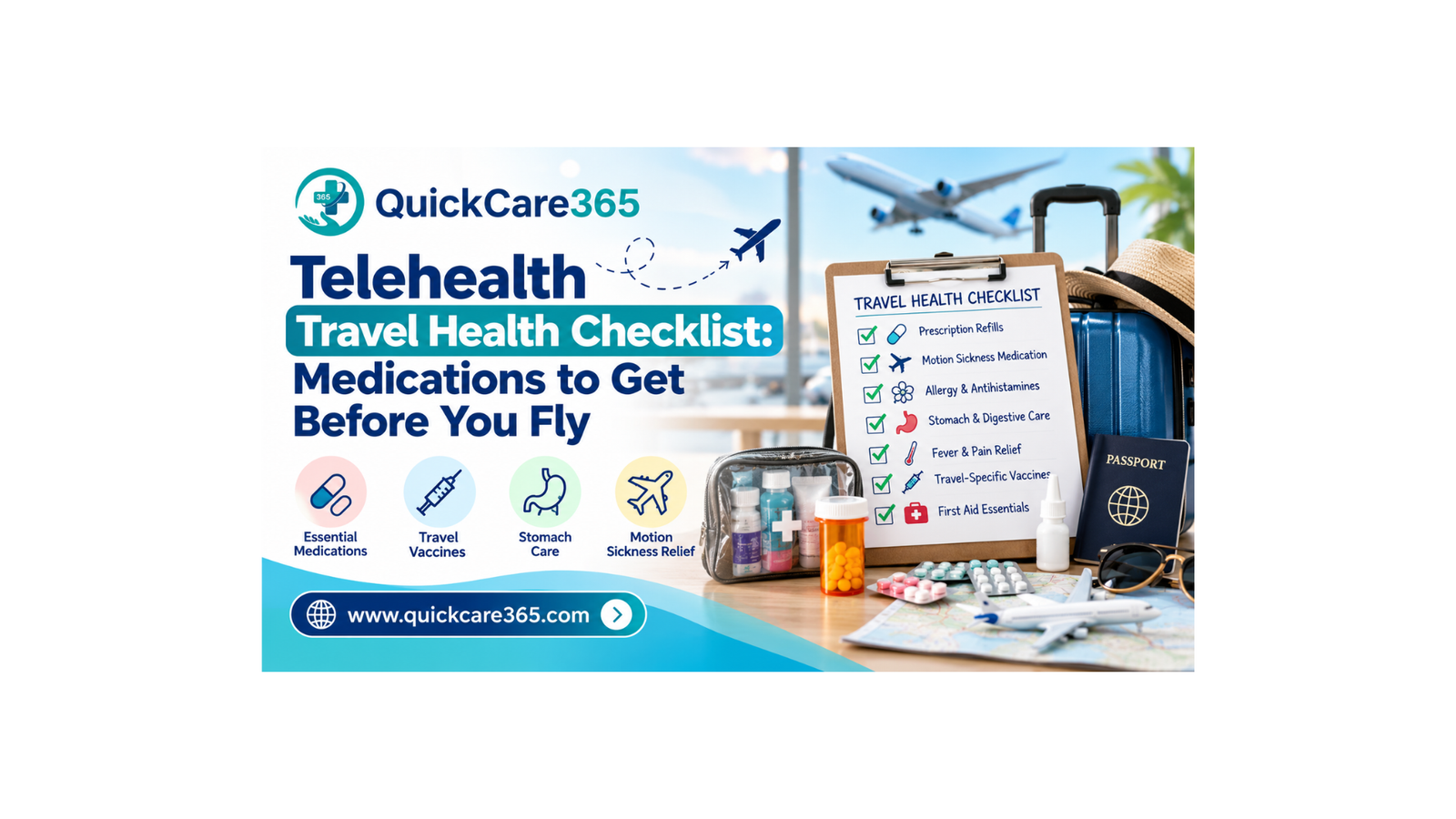
Book a travel health visit four to six weeks before you leave. That gives you time to sort out prescriptions (motion sickness, altitude sickness, a traveler’s diarrhea plan, and refills of your regular medications) and to get any vaccines, which have to be given in person. A telehealth visit can handle the prescriptions. Vaccines and yellow fever certificates need a travel clinic.
Your pre-travel timeline
| When | What to do |
|---|---|
| 6–8 weeks out | Check the CDC Travelers’ Health page for your destination. Book a travel clinic if vaccines or malaria prevention are recommended. |
| 4–6 weeks out | Telehealth visit for travel prescriptions. Confirm you’ll have enough of your regular medications. |
| 2 weeks out | Fill prescriptions. Get a letter listing your medications. Check your destination’s rules on controlled medications. |
| 1 week out | Pack your medical kit. Make copies of prescriptions. |
| Travel day | All medications in your carry-on, in original containers. |
The checklist
| Item | OTC or prescription | Notes |
|---|---|---|
| Motion sickness medication | Both | The prescription patch goes on hours before travel |
| Traveler’s diarrhea kit | Both | Oral rehydration salts and loperamide; an antibiotic only if prescribed |
| Altitude sickness medication | Prescription | Only for destinations above about 8,000 ft |
| Regular prescriptions, plus extra | Prescription | The whole trip plus several days’ buffer |
| Pain and fever reliever | OTC | Acetaminophen or ibuprofen |
| Antihistamine | OTC | Allergies, bites, mild reactions |
| Hydrocortisone cream | OTC | Bites and rashes |
| Insect repellent and sunscreen | OTC | DEET or picaridin repellent |
| Medication list and prescriber letter | — | Use generic drug names |
Motion sickness
Over-the-counter options such as meclizine and dimenhydrinate work well for many people. Take them before travel starts; they can cause drowsiness.
For longer journeys such as cruises, a prescription scopolamine patch is often more effective. It goes behind the ear at least four hours before you need it and works for up to three days. Side effects include dry mouth and blurred vision, and it isn’t suitable for everyone, including people with certain types of glaucoma. Older adults should use it with caution.
Practical measures help too: sit where motion is least (over the wing, or midship on a boat), look at the horizon, and avoid reading.
Traveler’s diarrhea
This is the most common travel illness. Depending on the destination, it affects somewhere between 30% and 70% of travelers.
Prevention: eat food that is cooked and served hot, drink bottled or treated water, and be cautious with ice, raw salads and unpeeled fruit.
Treatment: rehydration comes first. Pack oral rehydration salts. Loperamide can ease mild to moderate symptoms, but don’t use it if you have a fever or blood in your stool.
Antibiotics: routine preventive antibiotics aren’t recommended. For some high-risk destinations, a provider may prescribe a standby antibiotic to take only if severe symptoms develop. Ask about this at your visit rather than self-medicating abroad.
Altitude sickness
This matters if you’re traveling above roughly 8,000 feet (2,500 meters), which includes parts of the Andes, the Himalayas and some Rocky Mountain resorts.
Gradual ascent is the best prevention. For higher-risk itineraries, a provider may prescribe acetazolamide, usually started the day before you climb. Tell your provider if you have a sulfa allergy. If symptoms become severe (confusion, breathlessness at rest, trouble walking), go down immediately. Medication is not a substitute for descent.
Managing your regular medications abroad
- Pack enough for the whole trip, plus a few extra days in case of delays.
- Keep medications in their original, labeled containers.
- Pack them in your carry-on, never in checked luggage. The TSA allows medically necessary liquids over 3.4 ounces; declare them at screening.
- Carry a letter from your prescriber listing each medication by its generic name.
- Check your destination’s rules on controlled medications. Some countries restrict drugs that are routine in the US. Japan, for example, prohibits amphetamine-based ADHD medications such as Adderall. Check the destination country’s embassy guidance before you go.
- Plan dosing across time zones for time-sensitive medications such as birth control pills and insulin. Ask your provider for a schedule.
What telehealth can’t do for travel
- Vaccines. They must be given in person.
- Yellow fever vaccination. This is only available at registered centers, which issue the international certificate some countries require for entry.
- Malaria prevention for high-risk destinations. This is best planned with a travel medicine specialist, who will match the medication to your specific itinerary. [EDITORIAL: confirm whether QuickCare365 prescribes malaria prophylaxis and edit accordingly.]
Special situations
Pregnancy. Some travel medications, including certain antibiotics and altitude and malaria medications, aren’t suitable in pregnancy. Some destinations carry specific risks, such as areas with Zika transmission. Speak to your obstetric provider as well as a travel provider before you book.
Children. Doses differ by age and weight, and some adult options aren’t suitable for children. The scopolamine patch, for example, is not recommended for them. Pack children’s formulations of fever reducers and oral rehydration salts rather than planning to split adult tablets.
Chronic conditions. If you have diabetes, heart disease, asthma or a weakened immune system, plan for how you’d manage a flare while away. Carry extra supplies (inhalers, glucose monitoring equipment, spare batteries) and a summary of your condition and treatment.
If you get sick while abroad
US telehealth providers must be licensed where you are physically located during the visit, so most can’t treat you while you’re outside the country. Before you go:
- Get travel insurance that covers medical care, and consider evacuation cover for remote destinations.
- Save the US embassy’s list of local doctors for your destination.
- Enroll in the State Department’s Smart Traveler Enrollment Program (STEP).
If you develop a fever after returning from a malaria-risk area, get medical care promptly and tell the clinician where you traveled.
How a telehealth travel visit works
Book a consultation and share your destination, travel dates, itinerary, activities, current medications and allergies. The provider will recommend what you need and send any prescriptions to your pharmacy, and they’ll tell you if you also need a travel clinic.
QuickCare365 offers travel health consultations from $14.99, 8:00 AM to 11:00 PM, seven days a week.
Frequently asked questions
How far ahead should I book? Four to six weeks, or six to eight if you may need vaccines.
Can I get my regular prescriptions refilled early for travel? Often, yes. Many insurers allow a “vacation override.” With self-pay, your provider can prescribe the quantity you need.
Can telehealth give me travel vaccines? No. Vaccines must be given in person.
Do I need a letter for my medications? It’s strongly recommended, especially for injectables, controlled medications and anything with needles or syringes. A letter listing generic names helps with customs and with local pharmacies if you lose your supply.
Can children take motion sickness medication? Some over-the-counter products are labeled for children over a certain age. The scopolamine patch is not recommended for children. Ask a provider for age-appropriate options.
What if I get sick abroad? Use your travel insurance and the embassy’s list of local doctors. A US telehealth provider generally can’t treat you outside the country.