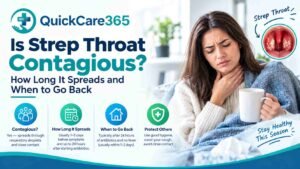
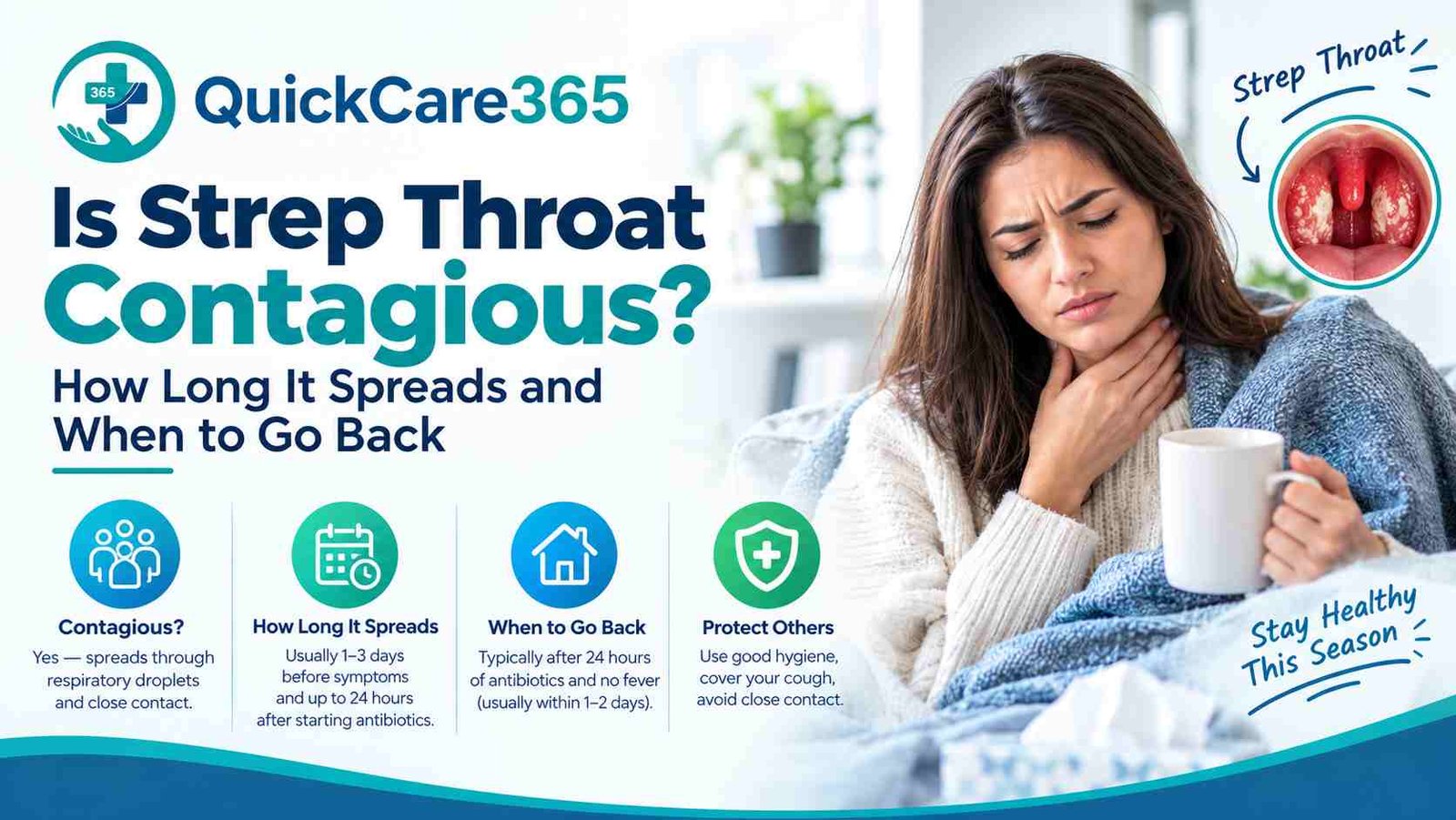
Yes, strep throat is contagious. It spreads easily through respiratory droplets and close contact. Once you start antibiotics, you’re generally no longer contagious after at least 12 hours of treatment, as long as your fever has gone, which is when CDC says you can return to work or school. Without treatment, you can stay contagious for two to three weeks.
The strep throat timeline
| Stage | Timing |
|---|---|
| Exposure to symptoms | Usually 2–5 days |
| Untreated | Contagious for up to 2–3 weeks |
| After starting antibiotics | Generally not contagious after at least 12 hours, once fever is gone |
| Feeling better | Usually within 1–2 days of starting antibiotics |
| Full antibiotic course | Typically 10 days. Finish it even after you feel better. |
How strep spreads
Strep throat is caused by group A Streptococcus bacteria. It spreads through:
- Respiratory droplets from coughing, sneezing or talking
- Sharing cups, utensils or food with someone who’s infected
- Touching sores from a strep skin infection, a less common route
- Touching contaminated surfaces and then your mouth or nose, which is possible but less common
Strep is most common from late fall through early spring, when people spend more time indoors together.
Who gets strep throat most often
Strep throat is most common in children aged 5 to 15, but anyone can get it. Adults at higher risk include:
- Parents of school-age children
- Teachers and childcare workers
- People in close-quarters settings such as dorms, barracks and offices
That’s why strep often moves through a household one person at a time after a child brings it home from school.
Going back to work or school
CDC advises that people with strep throat stay home until both of these are true:
- They’ve taken antibiotics for at least 12 hours, and
- They no longer have a fever
Some schools and employers ask for 24 hours of antibiotics, so check the policy. If you need documentation, add an excuse letter to your visit.
Why finishing the antibiotics matters
Most people feel much better within a day or two, and it’s tempting to stop. Don’t. Finishing the full course clears the infection properly and lowers the risk of complications such as:
- Peritonsillar abscess, a pocket of pus near the tonsil
- Rheumatic fever, which can damage the heart valves
- Post-streptococcal glomerulonephritis, a kidney inflammation
These complications are uncommon in the US today largely because strep is diagnosed and treated promptly.
Stopping strep from spreading at home
- Don’t share cups, utensils, food or toothbrushes
- Wash your hands often, especially after coughing or blowing your nose
- Cover coughs and sneezes
- Wash dishes in hot, soapy water or a dishwasher
- Watch other household members for a sudden sore throat and fever over the next few days
Many people replace their toothbrush after strep. The evidence that it prevents reinfection is limited, but it’s a cheap precaution.
Scarlet fever is strep with a rash
Some people with strep throat develop scarlet fever: a red, sandpaper-like rash that usually starts on the neck and chest, often with a bright red “strawberry” tongue. It’s treated with the same antibiotics, and the same contagious rules apply. Get it assessed promptly.
What about strep carriers?
Some people carry strep bacteria in their throat without being sick. Carriers are much less likely to spread it than people with active infection, and they usually don’t need treatment. That’s one reason a provider tests only when your symptoms suggest strep.
Is it strep or a virus?
Most sore throats are viral. Strep is more likely with a sudden severe sore throat, fever, swollen tonsils and tender neck glands, and without a cough or runny nose. A rapid strep test confirms it. Our strep throat page has a full side-by-side comparison.
When to seek urgent care
Go to urgent care or an emergency room if you have:
- Difficulty breathing or swallowing
- Drooling, or being unable to swallow saliva
- A muffled “hot potato” voice
- Severe pain on one side of the throat
- Swelling in the neck
- Symptoms that worsen after starting antibiotics
Strep in children: what parents should know
Children with strep often have symptoms beyond a sore throat: stomach pain, nausea, vomiting and headache are common, especially in younger school-age children. Some children don’t complain about their throat much at all.
Strep throat is uncommon in children under three. A sore throat with a runny nose and cough in a toddler is more likely viral.
If your child has a sudden sore throat with fever, especially without a cough, get them tested. Keep them home until they’ve had at least 12 hours of antibiotics and no fever.
Should everyone at home get tested?
CDC doesn’t recommend routine testing of household members who have no symptoms. Watch everyone for a sudden sore throat and fever over the next week, and test anyone who develops symptoms.
When strep keeps coming back
If you or your child get strep throat repeatedly, talk to a provider about seeing an ear, nose and throat specialist. Guidelines consider tonsil removal for frequent infections: for example, seven or more episodes in one year, five a year for two years, or three a year for three years.
How telehealth can help
A provider can assess your sore throat by video, arrange a rapid strep test at a nearby pharmacy, clinic or lab, and send antibiotics to your pharmacy once strep is confirmed. You stay home and avoid spreading it in a waiting room.
QuickCare365 strep throat consultations start at $14.99, 8:00 AM to 11:00 PM, seven days a week.
Frequently asked questions
How long is strep contagious without antibiotics?
Up to two to three weeks.
Can you get strep throat without a fever?
Yes, though fever is common. A test is the only way to confirm it.
Can adults catch strep from their kids?
Yes. Parents of school-age children are among the adults most likely to get strep.
Can you get strep more than once?
Yes. There are many strains, and having strep once doesn’t make you immune.
Do I need to stay home if I’m a carrier?
Carriers without symptoms are much less contagious and generally don’t need to stay home or be treated.
Can I catch strep throat from my dog or cat?
Pets aren’t known to spread group A strep to people, so there’s no need to treat your pets.
Disclaimer: This article is general information, not medical advice.